
Detachable Subdivision
"Rivne Professional College of
National University of Life
and Environmental Sciences of Ukraine"

If History is a witness of time, a teacher of life. (Cicero),
then Architecture points to eternity (Christopher Wren).

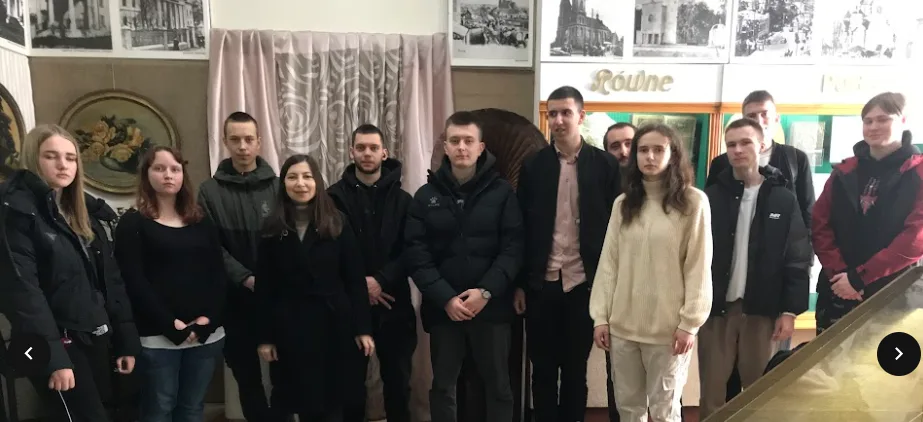
Before the Week of Construction Disciplines, as is tradition, students of groups 41, 42, and 11-B visited the "Old Rivne" excursion at the Rivne Museum of Local Lore. Since 2022, the "Old Town" excursion has not been operating due to the fact that it was being supplemented with new exhibits.
The first settlements on the territory of the modern city appeared a long time ago. In particular, the remains of settlements of primitive Cro-Magnon man, founded more than 15 thousand years ago, have been discovered here. Older settlements are found on the outskirts of the city, while its central part was settled later.
The first known written mention of Rivne is dated 1283 year. From the second half XIV century. Rivne was under the rule of Lithuanian princes. After the death of the prince in 1479 The city of Rivne became the property of his wife Maria, who began to call herself Princess Rivne. By her order, a castle was built of oak logs on one of the islands on the Usta River, which split into two branches. The original city resembled a triangle in plan, and accordingly the city streets diverged in three directions. Rivne could be entered from Kyiv, Ostroh, and Dubny. Hence the symbol of the ancient city coat of arms - a gate open for entry on three sides.

IN1492 In 1891, the Polish king and Grand Duke of Lithuania Casimir Jagiellon granted the town Magdeburg rights. In the census 1629 In 1911, it was recorded that there were 505 houses in Rivne and over 3,000 residents (Kyiv had 18,000 residents at that time). However, subsequent tragic events – wars, fires, and epidemics – led to a decrease in the population.
Since 1723 For a long time, almost a century and a half, the city passed into the ownership of the Polish nobles Lubomirski. In XVIII century. the princes of Lubomirski were the richest magnate family in Volhynia, and at times in the whole of Poland. With the arrival of the Lubomirskis, significant changes began in the life of the city. The Rivne castle was rebuilt into a palace complex, which was then in ruins and desolation. The palace complex, built on the Castle Island, formed by the flow of the river, was striking in its splendor.


The Lubomirskis' patronage of Jews, who were at that time being persecuted in neighboring European countries, led to their mass resettlement to Rivne. Over time, they settled in one of the city's districts, which had a significant and long-lasting impact on the national and religious life of the city.
IN 1857 r. the Kyiv-Brest highway ran through the city, and in 1873 r. – a railway line between these cities. The Rivne railway station appeared.Since 1723 For a long time, almost a century and a half, the city passed into the ownership of the Polish nobles Lubomirski. In XVIII century. the princes of Lubomirski were the richest magnate family in Volhynia, and at times in the whole of Poland. With the arrival of the Lubomirskis, significant changes began in the life of the city. The Rivne castle was rebuilt into a palace complex, which was then in ruins and desolation. The palace complex, built on the Castle Island, formed by the flow of the river, was striking in its splendor.


During World War I, Rivne was a front-line city for a long time. In 1916Before the Russian army's attack, Emperor Nicholas II and General O. Brusilov visited him. September 19, 1920 The city of Rivne was occupied by Polish troops, and by September it 1939 was part of the Polish state as the county center of the Volyn Voivodeship.
During the fascist occupation, the city was transformed into a kind of "capital" of the occupied Ukrainian lands. From September 1941 In the year, the “Reichskommissariat Ukraine” and the residence of the Gauleiter were located here.
IN 1950 In 1991, the reconstruction of the economy destroyed by the war was completed. And 60-80-those years were a period of intensive growth and development of the city, as a result of which its face changed radically.
Be grateful for what you have and don't forget to appreciate every moment of your life!
Alla PETRYKOVSKA,
teacher of construction disciplines
