
Detachable Subdivision
"Rivne Professional College of
National University of Life
and Environmental Sciences of Ukraine"

On October 10, in the village of Mali Kanivtsi in the Cherkasy region, Mykhailo Drai-Khmara was born - a poet and translator, scientist and teacher, and literary critic.
He came from a Cossack family. He studied at the Pavlo Galahan College in Kyiv at the Faculty of History and Philology of Kyiv University. During a long trip abroad, he studied the collections of libraries and archives in Lviv, Budapest, Zagreb, Belgrade, Bucharest - he studied Slavic languages.
In 1915-1917, he studied Slavic studies at St. Petersburg University as a professorial fellow. It was there, at the height of World War I, that Mykhailo Drai became Drai-Khmara. He attended lectures on Ukrainian history and participated in the work of the Ukrainian students' association.
After returning to Ukraine (1917) he became a professor at Kamianets-Podilskyi University, the Institute of Public Education, and the Kyiv Medical Institute. In 1930-1933 he worked at the Research Institute of Linguistics at the Ukrainian Academy of Sciences. It was in Kamianets-Podilskyi that he began writing poems in Ukrainian, and published them in periodicals.
Author of the collection "Prorosten" (the only one published during his lifetime, 1926), as well as the monograph "Lesya Ukrainka. Life and Creativity" (1926). He was fond of sports. He knew 19 languages.
“Above average height, with fair hair and a cheerful face, with a smile of white teeth and dreamy gray eyes,” described her father’s appearance by his daughter Oksana. “Neatness was his characteristic feature, starting from the manuscripts and well-arranged, selected library and ending with the impeccable quality of his clothes, artistic taste was felt in everything.”
In March 1933, he was arrested on charges of belonging to a counter-revolutionary organization, but was released two months later due to lack of evidence. On September 6, 1935, he was arrested again and sentenced to 5 years in a penal camp, which he later served another 10 years for ("participation in an anti-Soviet organization and anti-Soviet agitation").
He died on January 19, 1939, in a Gulag concentration camp in Kolyma. According to the official version, he died of "weakening of cardiac activity." He was rehabilitated in 1989.
Until I die, I won't stop.
To look for you on earth
And the heart of the starry field,
Where do your ships sail?
Locked in a deep cave
My soul rebels –
Oh, where is the sky, where is the blue,
That mortal pain comforts her?
Her breathing is like in childhood,
That fell into the ground with my grandmother,
And don't avoid me - I am your son -
And hold my forehead."
(Mykhailo Drai-Khmara. “Until I die, I will not stop…”)
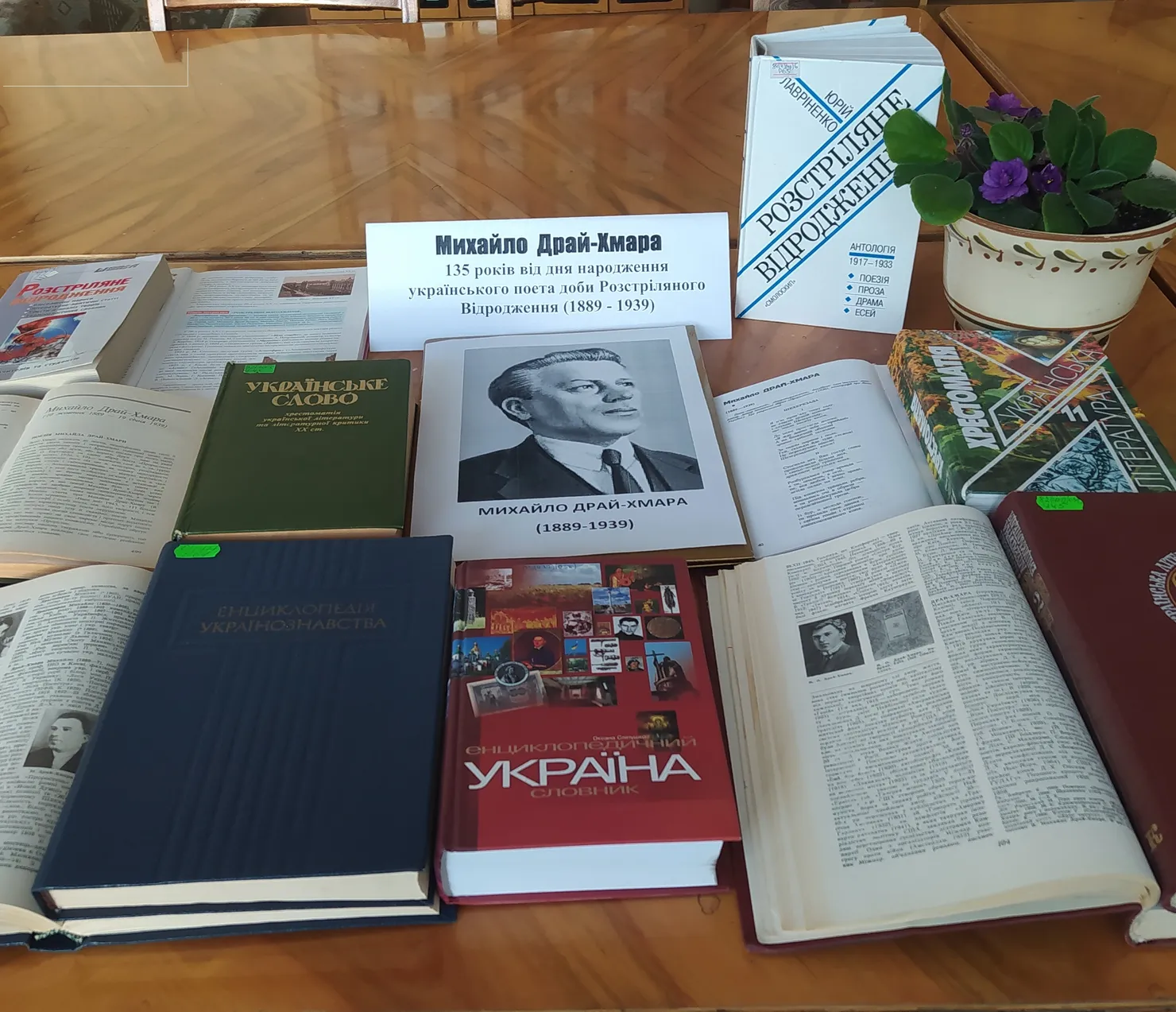
A book exhibition dedicated to the poet is presented to the attention of users in the college's library and information center. We invite you to view it.

Svitlana ANDRIYCHUK,
Lead Librarian of the BIC
