
Detachable Subdivision
"Rivne Professional College of
National University of Life
and Environmental Sciences of Ukraine"
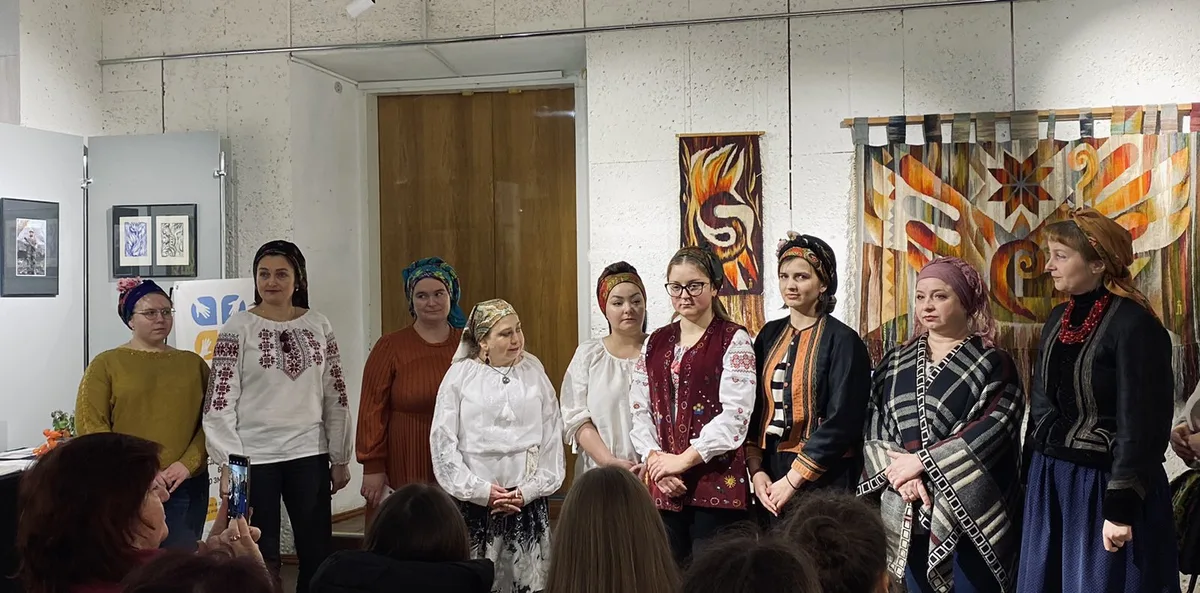

Every year on December 7, Ukraine celebrates Ukrainian Headscarf Day, a holiday that celebrates folk traditions, female beauty, and national culture. The headscarf has always had a deep spiritual meaning. It was used as a talisman that protected against evil forces, as well as a symbol of family ties. By passing the headscarf down from generation to generation, Ukrainians preserved their history, traditions, and memory of their ancestors. It was an important element of clothing: girls wore it as a decoration, and married women wore it as a mandatory headdress. Each region of Ukraine had unique patterns and colors of headscarves.
On December 5, the Rivne Regional Museum of Local Lore hosted an event dedicated to the Ukrainian kerchief - a symbol of folk culture and traditions, which was attended by students of the land law department.
The organizer of this event was the director of the Rivne Regional Museum of Local Lore, Alla Zhyzhkevych, who focused on the importance of preserving Ukrainian cultural heritage and its popularization. Alla Ukrainets, Honored Worker of Culture of Ukraine, a well-known researcher, local historian, ethnographer, senior research associate of the local history museum, demonstrated up to 30 different ways of tying scarves. Although the initiator claims that the traditional way of wearing a scarf has been partially lost, it remains an important symbol of national culture. There were also photographs from the late 19th and early 20th centuries, which depicted women with scarves tied in different ways. A shocking fact for visitors was that in ancient times not only women, but also men, wore and owned various techniques for tying scarves.
The participants had the opportunity to get acquainted not only with theoretical information, but also with practical ones. They learned to master the techniques of tying scarves with ribbons, characteristic of different regions of Ukraine, such as Poltava, Cherkasy, Vinnytsia, Kyiv, Zhytomyr and Galicia. Each region of Ukraine has its own characteristics of scarves - colors, ornaments and manufacturing techniques. For example, floral motifs were popular in Podillia, geometric patterns in Galicia, and restrained colors in Polissya. These features reflect the natural and cultural conditions in which regional identity was formed.
The event took place in an atmosphere of friendship and warmth, combining the traditions of the past with the present through the symbol of femininity and Ukrainian identity - the headscarf. Photos taken during the event reflect the various styles of tying, which is a manifestation of the creativity of Ukrainian women in decorating themselves and their headgear. Many women shared their memories of how their grandmothers and mothers taught them to wear headscarves at special moments in life.
This event once again confirmed the importance of the headscarf as an element of Ukrainian culture that unites generations.
A video about this event is available at by reference.


Angelika PRYSTUPA, Diana PILETSKA,
students of the 32nd group,
Iryna MATKOVSKA,
teacher of legal disciplines
