
Detachable Subdivision
"Rivne Professional College of
National University of Life
and Environmental Sciences of Ukraine"
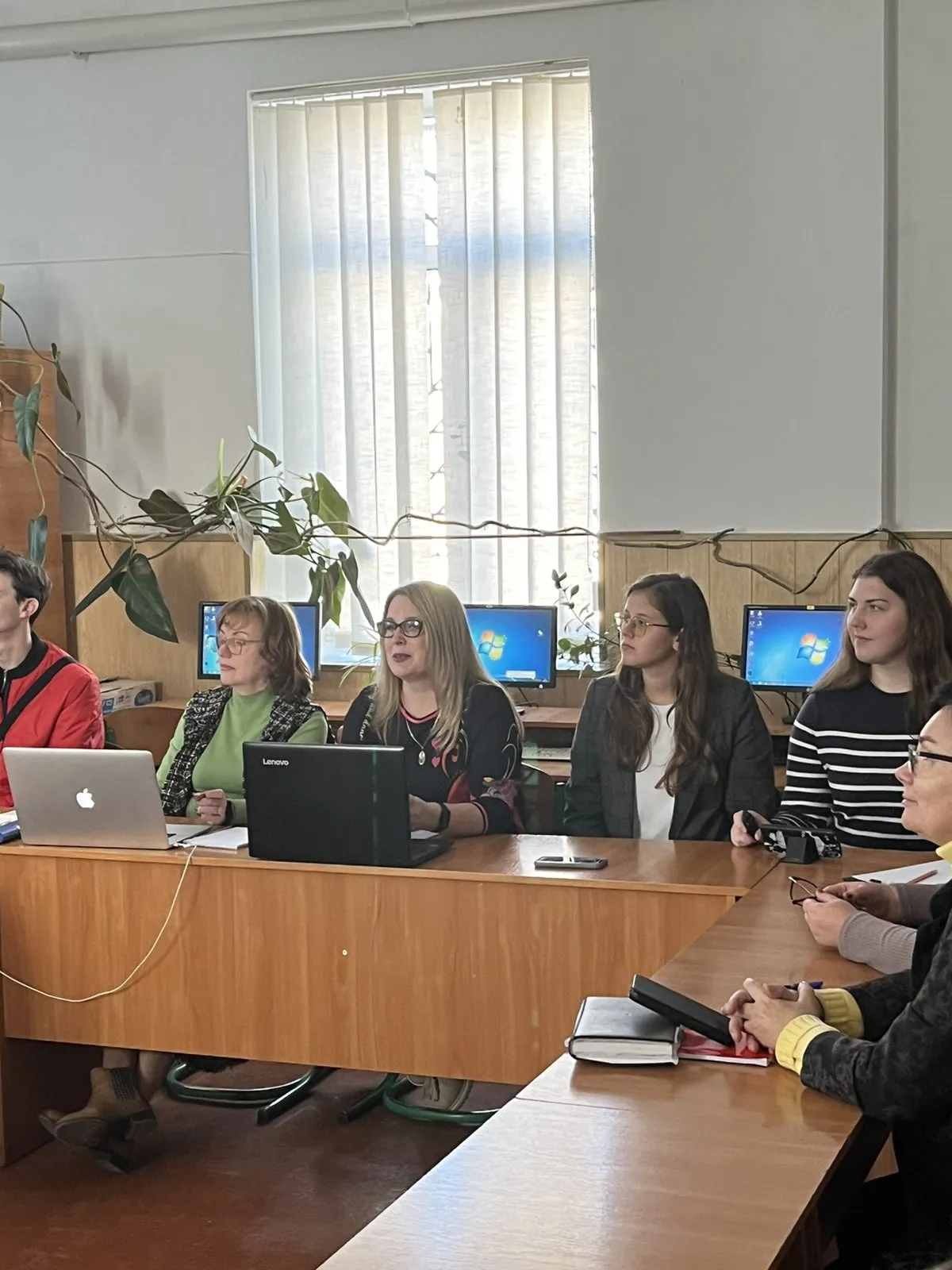

On October 23, 2024, as part of the week of economic disciplines and a meeting of the "Accountant" circle, a round table was held on the topic "Professional competence of an auditor in the context of European integration." The organizers of the event were the teachers of the economic department, Candidate of Economic Sciences, Associate Professor Alla HNATYUK and Candidate of Economic Sciences Oksana NEMKOVYCH.
The following were invited to participate in the round table: the director of the college, Doctor of Economics, Associate Professor Vasyl TSARUK, Deputy Director for Academic Affairs Lyudmila BALDYCH, the methodologist of the college, Doctor of Engineering Vadym LYULCHYK, the head of the economic department Iryna MARTYNOVA, the head of the cyclical commission of the economic department Oksana KONONCHUK, Doctor of Economics, practicing auditor, director of LLC "AUDIT COMPANY "AKTYV PLUS" Lyudmila MATVIYCHUK, as well as representatives of the National University of Life Resources and Environmental Sciences of Ukraine, Doctor of Economics, Professor of the Department of Statistics and Economic Analysis Inna LAZARYSHYNA and Doctor of Economics, Associate Professor of the Department of Accounting and Taxation Natalia KUZYK. The event was also attended by students of 4-OB, 5-OB, 31-O groups of specialty 071 "Accounting and Taxation".
The moderator of the round table, Oksana NEMKOVYCH, noted that an important goal of the event was to provide students with the opportunity to understand how global changes taking place in the field of economics and auditing in Europe affect the auditing profession in Ukraine.
The event began with short speeches by the participants:
1. Alla HNATYUK, teacher of economic disciplines, began with the topic "International Standards on Auditing (ISA) in the context of European integration". The speaker emphasized the importance of adapting Ukrainian audit practice to international audit standards, such as ISA 315, which concerns the identification and assessment of risks, ISA 540 - the audit of accounting estimates, and ISA 700, which determines the form of the audit report. It was noted that integration with European standards will contribute to improving the quality of audit services in Ukraine and harmonizing national legislation with European legislation.
2. Kateryna PAMYANOVSKA, a student of group 31-O, gave a report on the topic "Ethics and professional responsibility of an auditor in the context of European integration". In her report, she revealed the key ethical principles that auditors must adhere to in their work: independence, honesty, confidentiality of information. It was also emphasized that, given the European integration processes, the ethical standards of the profession in Ukraine must meet international requirements, which places additional responsibility on auditors.
3. Evelina SHATECKA, a student of group 31-O, presented the topic "Technology and digital competence of the auditor according to ISA". She noted that a modern auditor should not only be knowledgeable in financial matters, but also have skills in working with modern information technologies. The use of specialized software for analyzing large data sets, conducting risk analysis and identifying possible violations or fraud is becoming a necessary component of the auditor's professional activities in the context of European integration.
After the speeches, a lively discussion began, in which the participants had the opportunity to share their thoughts on the challenges facing modern auditors, as well as discuss the prospects for the development of the profession in the context of European integration. Students asked questions about the requirements for the profession, the features of international certification of auditors, and the use of the latest technologies in the audit process.
The event concluded with the moderator's summary, which emphasized the importance of continuous development of professional skills and adaptation to the requirements of the modern labor market. She also noted that such meetings are important for the formation of professional competence of students, as they allow not only to gain new knowledge, but also to acquire practical skills and discuss current issues with practicing auditors.


Alla HNATYUK, Candidate of Economic Sciences, Associate Professor, Teacher-Methodologist,
Oksana NEMKOVYCH, Candidate of Economic Sciences, lecturer and methodologist,
teachers of economic disciplines
